
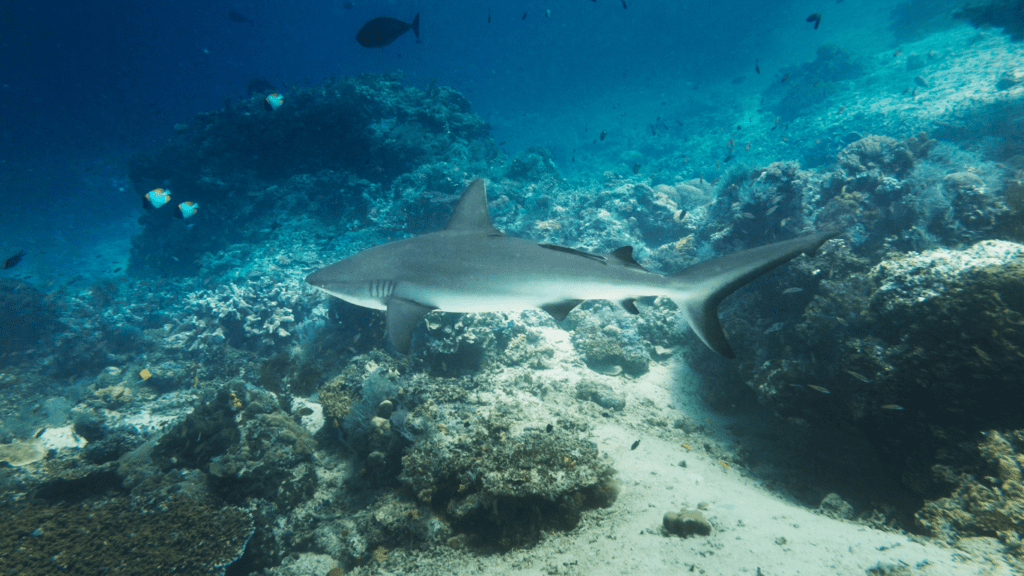
Few experiences compare to drifting effortlessly through crystal-clear water while sharks glide calmly past you. Sharks in Komodo National Park are not only one of the region’s greatest underwater highlights, but also a powerful reminder of why healthy oceans matter. For divers exploring Indonesia aboard a liveaboard like the KLM Eliya, encounters with sharks are often profound, inspiring, and unforgettable.
Komodo National Park is famous for its dramatic landscapes above water, but beneath the surface lies one of the richest marine ecosystems on Earth. Strong currents, thriving coral reefs, and protected waters create the perfect conditions for sharks to flourish — and where sharks thrive, the ocean is doing well.
Sharks play a critical role in maintaining balance in marine ecosystems. As apex predators, they regulate fish populations, prevent overgrazing of coral reefs, and help maintain biodiversity.
Without sharks:
In Komodo, the presence of sharks is a sign of resilience. These waters are protected, carefully managed, and respected by local communities and dive operators — allowing marine life to thrive naturally.
Divers exploring sharks in Komodo National Park are often surprised by both the diversity and frequency of encounters. Depending on conditions and dive sites, you may see:
These encounters are calm, natural, and awe-inspiring — offering a rare opportunity to observe sharks behaving exactly as they should: confident, curious, and completely uninterested in humans.
Komodo’s unique geography creates strong currents that bring nutrient-rich water to the reefs. This fuels plankton growth, attracts smaller fish, and in turn supports larger predators like sharks.
Key reasons Komodo stands out:
For divers, this means thrilling drifts, vibrant marine life, and frequent shark encounters — all in one destination.
A liveaboard is the best way to fully experience Komodo’s remote dive sites, and the KLM Eliya offers an experience that blends comfort, style, and adventure.
Unlike day trips, a liveaboard allows you to:
The rhythm of liveaboard diving creates space for meaningful encounters — not rushed moments, but real connections with the underwater world.
The KLM Eliya is designed for divers who appreciate both adventure and comfort. With spacious decks, thoughtfully designed cabins, and attentive service, the experience feels personal and relaxed — without sacrificing authenticity.
After an exhilarating dive with sharks, you can unwind on deck, enjoy freshly prepared meals, and watch Komodo’s dramatic landscapes pass by. It’s a gentle luxury that enhances, rather than distracts from, the natural beauty around you.
At Scuba Junkie Liveaboard, shark encounters are always conducted responsibly. Respectful diving ensures both diver safety and animal well-being.
Best practices include:
These simple behaviors allow sharks to remain relaxed, resulting in more natural and rewarding encounters.
Responsible dive tourism plays a vital role in protecting sharks. By choosing ethical operators and protected destinations like Komodo, divers help demonstrate that live sharks are worth far more alive than fished.
Shark-focused tourism:
Every dive becomes part of a bigger story — one where exploration and protection go hand in hand.
No. Sharks in Komodo are accustomed to divers and rarely show aggressive behavior. Calm, respectful diving ensures safe encounters.
Sharks can be seen year-round, but sightings are especially common during periods of stronger currents.
Some sites require experience due to currents, but Scuba Junkie offers guidance to match dives with skill levels.
Sharks regulate fish populations, which helps prevent coral overgrowth and reef degradation.
Yes. Liveaboards provide access to remote sites, flexible schedules, and a more immersive experience.
Through responsible diving practices, education, and support for marine protection initiatives.
Learn more about shark conservation at https://www.sharktrust.org
Encountering sharks in Komodo National Park is more than a thrilling dive — it’s a reminder of how powerful and delicate ocean ecosystems are. Aboard the KLM Eliya, divers don’t just visit Komodo; they become part of it.
With thoughtful luxury, responsible practices, and world-class diving, Scuba Junkie Liveaboard offers an experience that inspires respect for the ocean — and the incredible sharks that call it home.
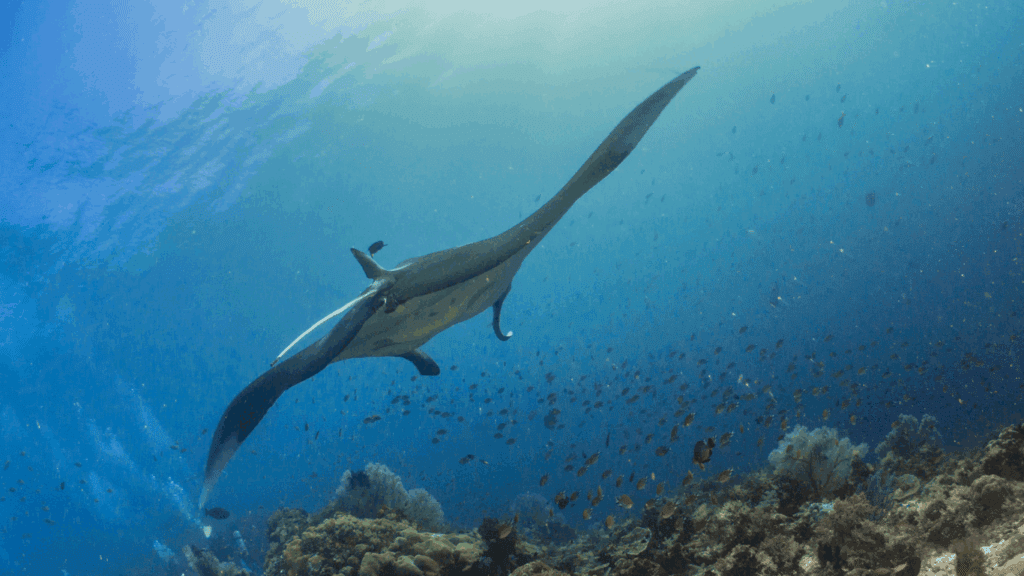
Let’s talk about Manta Rays in Komodo.
There are moments underwater that stay with you for life.
When a manta ray appears — wings spread, moving with effortless grace — everything slows down. The silence deepens. You forget the world above. These creatures don’t just swim. They fly.
To dive with a manta ray in Komodo is to witness something sacred.
It’s humbling. Magical. And increasingly, a privilege we might not always have.
As we mark Manta Day on September 17th, let’s dive into why these gentle giants matter — not just to divers, but to the planet. From the facts that make them extraordinary, to the dangers they face and the safe havens like Komodo, where they still thrive, this is a story worth sharing.
Manta rays feed on plankton — tiny organisms floating near the ocean’s surface. Using their large, gaping mouths and cephalic fins (those horn-like flaps), they filter hundreds of liters of water every hour, consuming microscopic algae and zooplankton.
This makes them key players in controlling plankton blooms, keeping ecosystems balanced and healthy — much like whales, turtles, or sharks do in other ocean layers.
They don’t eat fish. They don’t attack. They simply flow.
There are two main species of manta rays:
In Komodo, you can encounter both. And if you’re lucky, you might meet a melanistic (black) manta, whose inky body glides like a shadow through the sea. They’re rare, mysterious, and unforgettable.
Manta rays can live for up to 40 years, but they reproduce slowly — only one pup every few years. This makes their populations extremely vulnerable to overfishing and habitat loss.
Even small population declines can take decades to recover. And in many places, they’re not recovering at all.
While manta rays are beloved by divers, they face serious threats:
The IUCN lists both reef and oceanic mantas as vulnerable to extinction.
Thankfully, not all is lost. Some places — like Komodo National Park — are still safe havens for manta rays.
In 2014, Indonesia declared manta rays a protected species, making it illegal to catch or harm them. Komodo offers them abundant plankton, strong current systems, and protected cleaning stations where they return regularly.
Cleaning stations are coral outcrops where small fish like wrasses and butterflyfish clean parasites and dead skin from larger animals.
Manta rays return to these sites repeatedly — hovering calmly while cleaner fish do their job. For divers, this means predictable, respectful encounters with mantas that may last for minutes at a time.
In Komodo, top manta cleaning stations include:
These sites are carefully monitored and protected, allowing both mantas and marine life to thrive.
Look underneath a manta ray and you’ll see a constellation of black spots on their bellies — these are unique identifiers, like fingerprints.
Scientists use them to track individual rays over years, helping with population studies and migration patterns. Divers can even submit photos to conservation databases like MantaMatcher.org to contribute to global research.
A single live manta ray can generate over $1 million in tourism revenue during its lifetime, according to studies by Manta Trust. In contrast, one killed for its gill plates is worth less than $200.
Protecting mantas not only helps the reef — it helps communities. That’s why ecotourism-focused destinations like Komodo and Raja Ampat are crucial models for conservation.
With some of the largest brains of any fish, manta rays show signs of learning, memory, and even play. Some scientists believe they may have self-awareness, making them one of the most intelligent species in the ocean.
When a manta swims by and turns to look at you — make no mistake — they see you. And they remember.
To dive with manta rays in Komodo is to witness something ancient and free. It’s not just a “tick off the list.” It’s a reminder of what we stand to lose — and why we must protect it.
They don’t speak. But they tell us everything we need to know about the fragility and beauty of our blue planet.
Manta rays in Komodo represent more than a bucket list dive. They’re a symbol of harmony, of ocean health, and of what’s possible when we protect, not exploit.
Let’s make sure that future generations will still look up during a dive and feel the magic of a manta ray gliding past — just like we do today.
We’d love to hear your story — or help you plan your first one. Drop your thoughts in the comments below.
Komodo National Park sits in The Coral Triangle between the islands of Flores & Sumbawa in the Indonesian archipelago. The National Park is made up of 3 main islands – Komodo Island, Rinca Island and Padar Island as well as a number of smaller islands. This area is on the line of two continental plates and has been recognised by UNESCO as a “global conservation priority area” with unparalleled terrestrial and marine ecosystems.
The National Park covers nearly 2000 km2 with much of that being made up of the marine waters.
History of Komodo National Park
Komodo National Park was established in 1980 by the Indonesian Government as a sanctuary to protect the endangered Komodo Dragons. The Komodo Dragons or Varanus Komodoensis are the world’s largest lizard and are endemic to this area (can not be found anywhere else in the world!).
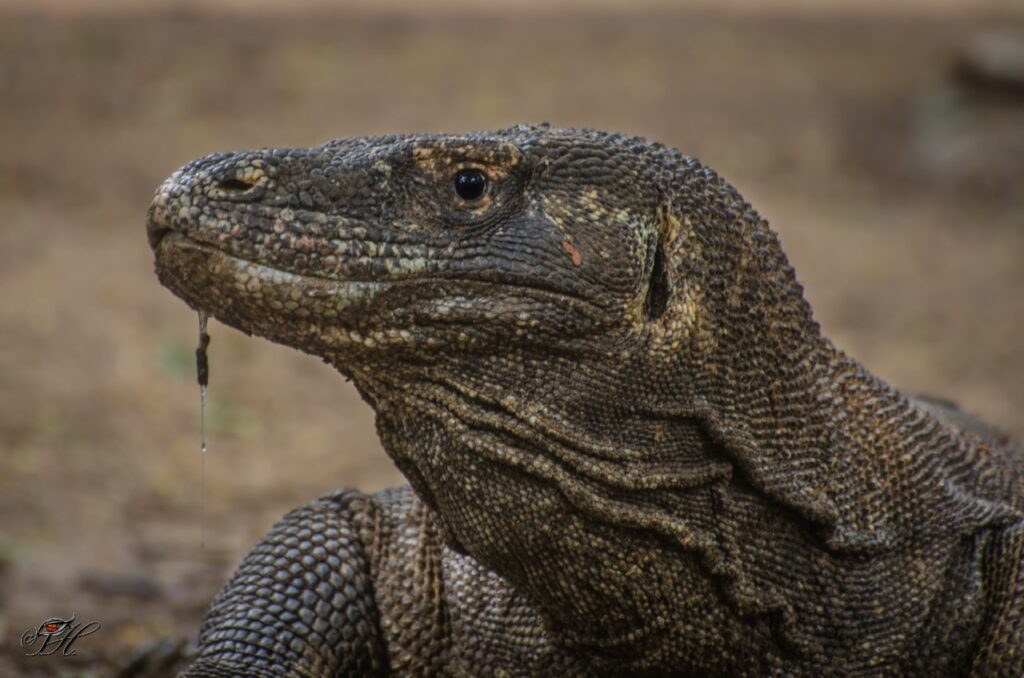
As part of your trip onboard KLM Eliya our Crew will take you to one of the Ranger Stations to give you the opportunity to spot these incredible beasts in their natural habitat.
In 1991, Komodo National Park was declared a UNESCO World Heritage Site and a Man and Biosphere Reserve. It is considered one of the world’s 25 biodiversity hotspots. A biodiversity hotspot is a region with significant levels of biodiversity that is threatened by human habitation.
Komodo National Park was initially protected because of the Komodo Dragons, but it was not long before people started to appreciate the shear beauty of what was under the surface of the ocean as well!
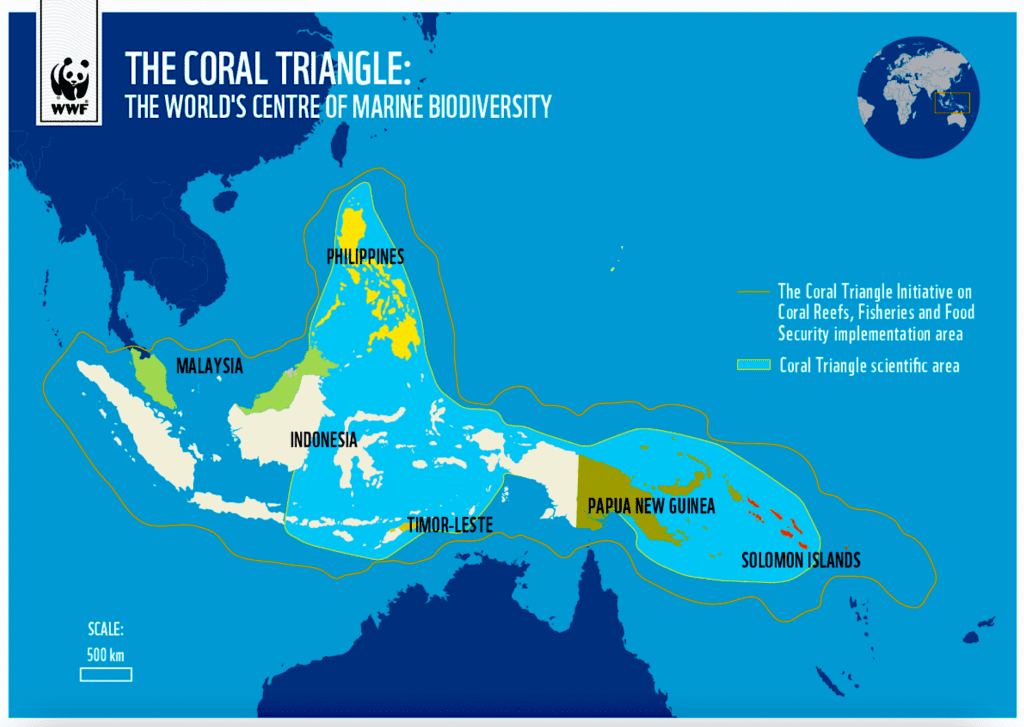
The Coral Triangle
Komodo National Park sits within the boundaries of The Coral Triangle. This is the world’s richest area for marine life. Often referred to as the ‘Amazon of the Ocean’ the Coral Triangle is home to over 6,000 fish species & 76% of the world’s coral species. 6 of the world’s 7 marine turtles are found here as well as an abundance of other popular marine animals such as mantas, sharks, molas, frogfish, blue ring octopus and much much more!
The Coral Triangle has 15 regionally endemic coral species (species found nowhere else in the world), and shares 41 regional endemic species within Asia.
This region covers a 6 million km2 area encompassing Indonesia, Malaysia, the Philippines, Papua New Guinea, Timor Leste and the Solomon Islands.
The Impact of Water Movement
The Coral Triangle is hit by two nutrient rich currents – the North Equatorial Current and the South Equatorial Current. These feed the coral reefs and the thousands of marine animals that live here, from the tiniest creature to the largest animal.
Komodo National Park is widely considered to have some of the world’s most challenging diving due to the currents that we get here. The strong currents are caused by the Indonesian Throughflow (ITF).
Trade winds and ocean currents run in opposite directions here, so the Pacific Ocean, to north east of Indonesia, is 20 cm above average sea level, while the Indian Ocean, in the southwest, is 10 cm lower than the average sea level. This 30 cm difference results in a massive movement of water from the “higher” Pacific Ocean through the archipelago’s complex underwater topography out into the “lower” Indian Ocean.
All of this runs through the narrow passages between the islands of Bali & Lombok, Lombok & Sumbawa, Sumbawa & Flores.
If we narrow this further to the Komodo National Park we have:
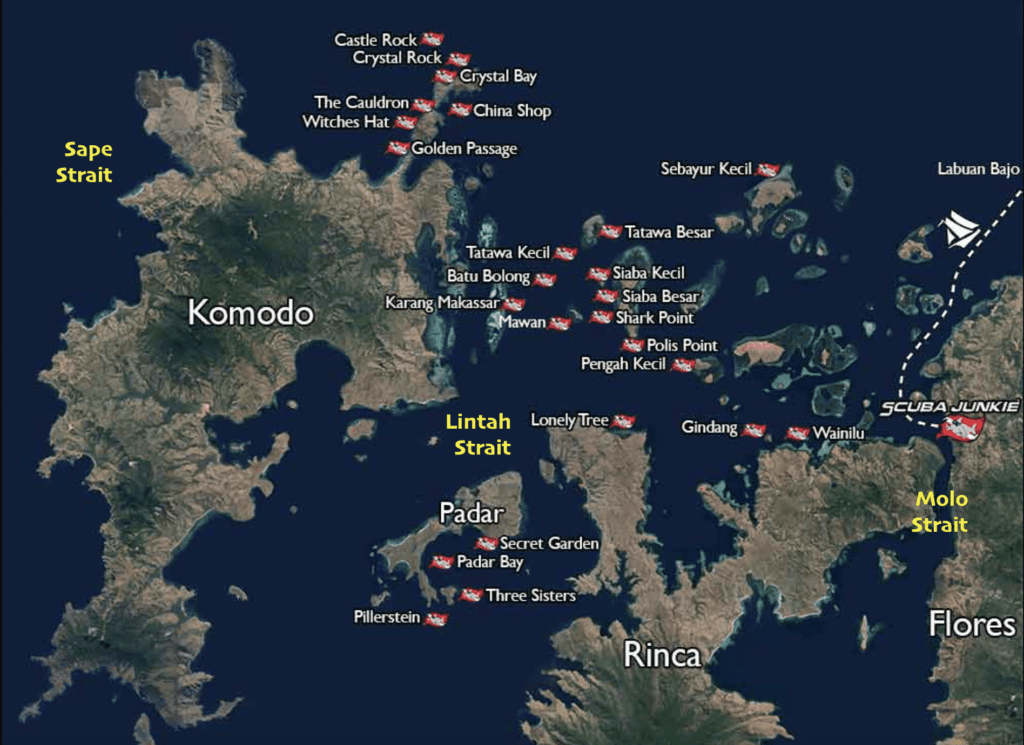
This island top0graphy as well as the dramatic ocean floor of deep trenches and shallow banks result in, not just fantastically fun diving(!!), but a rich and diverse area that results in some of the very best coral coverage and marine life diversity that you will see anywhere in the world!
KLM Eliya offers 6 Day / 5 Night Trips in the Komodo National Park and our Dive Guides onboard have worked in the area for many years. So feel free to ask them lots of questions when you are onboard!
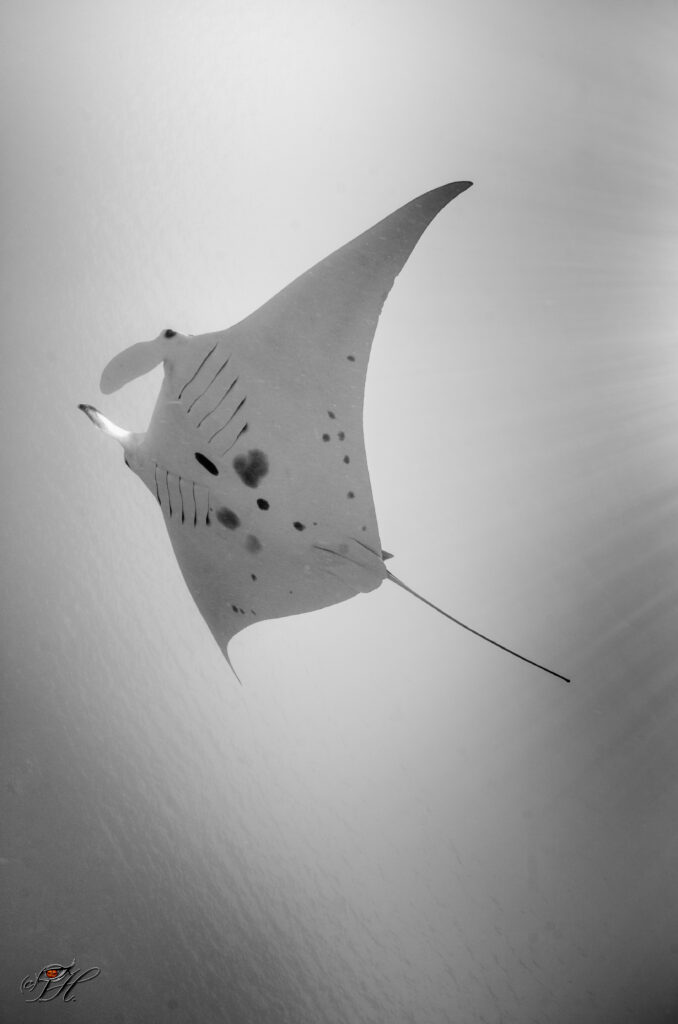
Manta Rays are majestical creatures that are on many divers’ bucket list! Here in Komodo the resident population sits at about 1200 identified individuals and scuba divers travel from all over the world to dive with these amazing animals. Manta etiquette and the right way to behave underwater is hugely important for all of us, as divers, to understand.
You may or may not know that individual mantas are identified by the pattern on their bellies! The belly spots on each manta are totally unique like the human fingerprint so each time a new manta is identified it is logged in the Marine Megafauna database which is why we can state with confidence there are over 1200 different individuals in Komodo National Park!
Why Komodo?
The fast currents and nutrient rich waters of Komodo help to keep our resident population happy and full! Mantas can be found at many of the dive sites in Komodo, but are most commonly found at Karang Makassar (a.k.a Manta Point), Mawan and Manta Alley. These dive sites in particular have Cleaning Stations that mantas enjoy to spend time at.
Manta Etiquette
Mantas are majestic, intelligent creatures and it is important that our interaction with them (as well as all forms of marine life) is as un-intrusive and respectful as possible!
Dive Guides will tell you during the dive briefings that it is important that we do not touch and do not chase the marine life. This goes for all creatures from the biggest manta to the smallest nudibranch.
Our interaction with mantas is often talked about and organisations such as the Marine Megafauna Foundation (MMF) offer specific guidance on how we should act while in the presence of these awesome animals.
Let’s take a look at some of the important points to remember below:
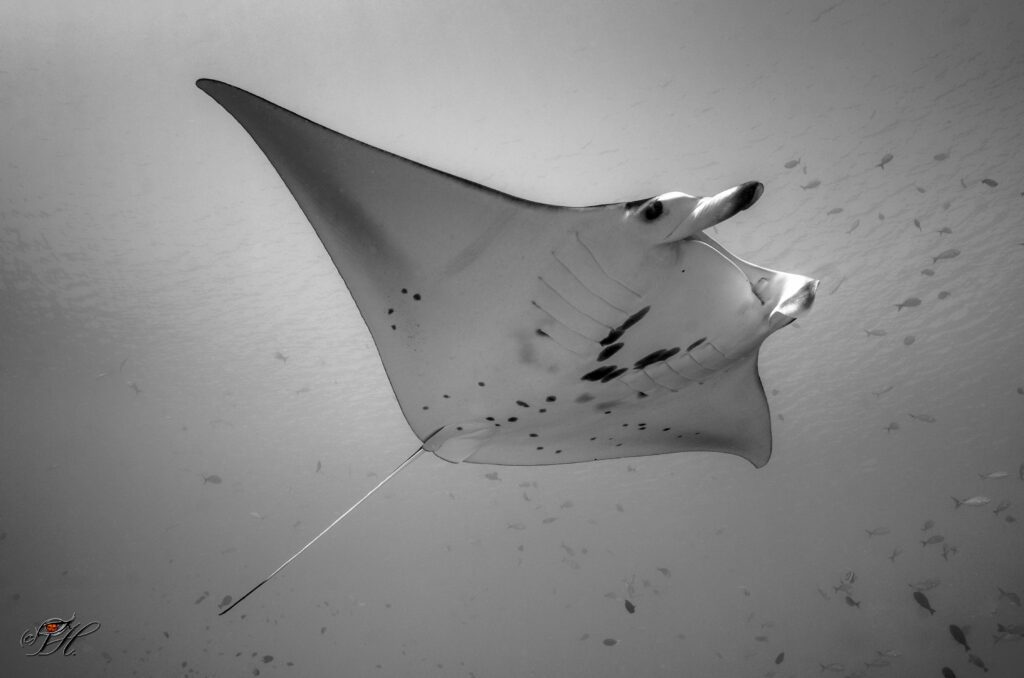
First of all what is a Cleaning Station?
Cleaning Stations are locations where different marine life will come to be cleaned by smaller creatures. Cleaning Stations can be found in both freshwater and marine environments and are used by a wide variety of animals.
Cleaning Stations are great examples of mutualism. This refers to a mutually beneficial ecological relationship between different creatures.
Mantas love Cleaning Stations!! They have often been shown to spend up to 8 hours per day cleaning and incredibly have also been shown to have favourite stations. Individuals have actually been recorded choosing one Cleaning Station over another!
As a manta approaches a Cleaning Station they slow their approach and will often look like they are “hovering” in one spot. Smaller creatures such as cleaner wrasse and butterfly fish will then approach the manta and help to clean the external surfaces by removing dead skin and and parasites they may find. As mentioned this process can sometimes last for hours and the manta will move in and out of the Cleaning Station in a loop pattern to make the most of the experience!
Cleaning Stations are an integral part of a manta’s life cycle and play a huge role in ensuring their health and wellbeing.
If you have been lucky enough to see mantas while cleaning you will see how elegant and “polite” the process is.
If there are multiple individuals at one Cleaning Station they will patiently wait and take turns moving in and out of the area. This process can last for hours with each looping around to the Cleaning Station pausing over the reef for moments at a time until they move out and the next individual will move in.
As scuba divers it is very important for us to be respective of this behaviour and ensure we don’t interrupt the line! This is why we recommend that all divers stay at least 3 metres away from the Cleaning Station area. If we are to encroach on this area the mantas will move away quite quickly to give us – the human – space to be cleaned! The smaller creatures doing the cleaning will also move away and hide among the coral and rocks as they are fearful of quick and sudden movements.
Your Dive Guides will always be keeping on eye on the group to ensure that an over excited diver isn’t getting too close and we will give you a little tap to call you back. If everyone follows this simple rule it means we can enjoy the show for the duration of the dive as it is likely we will be ready to leave due to air consumption before the mantas are finished cleaning!
Other important things to note:
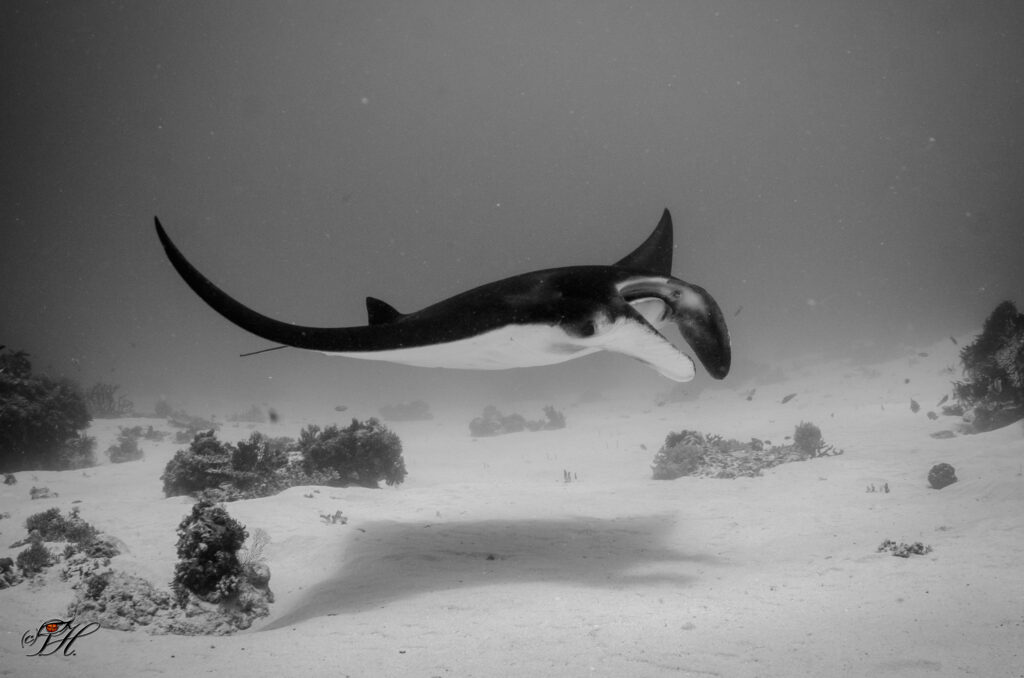
Mantas are large animals with the Reef Manta (aka Manta Alfredi) reaching a wingspan of 3-4 metres on average. It is important that we don’t chase or approach mantas from behind as they will often interpret this as predatory behaviour and swim away. With their large wingspan they are much faster than we are!
It is important also not to approach from above (especially so for snorkellers) as again they will interpret this as danger and move away.
Mantas do not respond well to divers who are moving quickly so being slow and remaining still is the best option.
It is vital that we never attempt to touch any marine life. A manta, if feeling secure and confident, is very inquisitive and there are many individuals here in Komodo that like to come in close and have a look at us divers! Mantas can come within centimeters of the a diver and it is so important that we do not try to touch them (although we understand the temptation!). Mantas have a protective film on their skin and human oils (even underwater) from our fingertips can be damaging to this.
The best advice we can give you
Let the mantas control the interaction! You will hear our Dive Guides say this a lot and we can promise you that this approach will give you the very best opportunity to enjoy magical experiences with these animals underwater.
Mantas are smart and intelligent, if they feel in control and not threatened they will often come closer and stay around for longer. We tell our divers to stay relaxed, stay calm, don’t move too much, don’t try to chase or touch or get close and they are more likely to come to you!
A quick recap:
If you would like to find out more about the Mantas of Komodo and the best time to dive here please get in touch now!